Did you know...
- Intermittent fasting was a part of our tradition long before physicians recommended it.
- The Prophet (s) told a companion, Zahir bin Haram, who struggled with body image confidence, that he was valued in the eyes of Allah.
- Islam emphasizes the importance of consent and respect for personal boundaries, such as maintaining privacy in the bathroom and seeking permission before entering a room.
- Islam views entertainment as a human need. After striving for Allah's sake, we are encouraged to relax and have fun with permissible activities.
- The Prophet (s) advocated for social justice in a society that practiced racism, tribalism and patriarchy.
- A companion with an alcohol problem was defended by the Prophet (s) when others cursed him.
- The women of Al Madinah were encouraged to have strong personalities and inquisitive minds.
- The Prophet (s) taught a young companion, al-Fadl, to take personal responsibility for controlling his sexual urges by lowering his gaze.
- The Prophet(s) experienced a year-long sadness at the loss of his wife and uncle and worried when the religion of Allah was mocked. He relied on Allah Y and the community for emotional support.
- The most important qualities to focus on when seeking a spouse are not wealth or ethnicity, but character and religion, according to the Prophet (a)
- Fulfilling our responsibilities towards our parents has a profound impact on our life in this world and the Hereafter.
- Remembering Allah, reciting the Qur'an and engaging in morning and evening thike routines comforted the Prophet (s) and served as a self-help mental health treatment.
After graduating from West Virginia School of Osteopathic Medicine, Amber Khan went on to pursue health education. She has been a Muslim youth educator since 2010, teaching physical, social, mental, reproductive and sexual health education at schools and community centers. She has also been chair of the Education Committee for the Islamic Medical Association of North America (IMANA) since 2015 and community educator for The Family and Youth Institute since 2021.
Sister Amber also holds an associate's degree in Islamic Studies from Mishkah University with focuses on Aqeedah and Dawah.
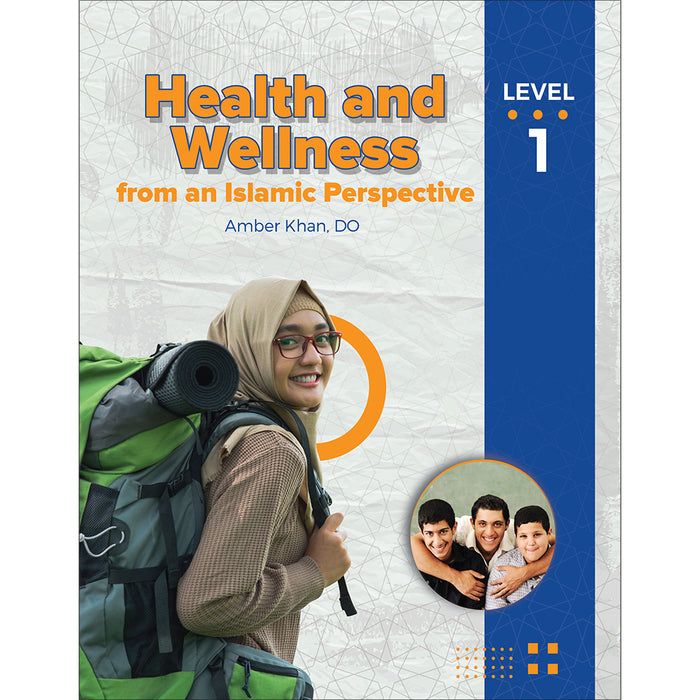
The Health and Wellness: From an Islamic Perspective series is a comprehensive collection of books that delves into the vital aspects of health and well-being of youth from an Islamic standpoint. This series is the first of its kind to tackle the Muslim youth's most common health concerns by putting the Islamic way of life at the forefront of its answers and centering the Muslim narrative. Through practical guidance, insightful explanations based on research and relatable examples and graphics, this series serves as a preventive intervention. By learning health from an Islamic perspective, Muslim youth may be more likely to practice Islam with confidence, reduce engagement in risky behavior and improve their overall physical, mental and spiritual well-being.
From Level 1 to Level 6 The Health and Wellness: From an Islamic Perspective series offers a structured, age-appropriate approach filled with valuable knowledge that empowers Muslim youth to make informed choices and embrace a balanced lifestyle rooted in Islamic values. Catering to the diverse needs and developmental stages of readers, the books cover a wide range of topics, such as personal hygiene, nutritious eating, physical fitness, puberty, sexual health, mental illness, social health, body image, drug use, contemporary health issues, stress management and spiritual health
The Health and Wellness: From an Islamic Perspective series can be used in schools, Islamic study circles or homes, serving as an invaluable resource for parents, educators, youth leaders, imams and mental health professionals.
Have you ever considered how to nurture your students’ or children’s faith in Islam through a health education curriculum? This series delves into the wisdom underlying Islamic practices and beliefs, showcasing how they are precisely formulated by the One, All-Wise and All-Knowing Creator. Since this book falls within the category of health education, it addresses important health topics while adopting an Islamic perspective. These topics are presented with a focus on their relevance, engaging pedagogy, and age appropriateness.
The series offers insights and answers to numerous questions confronting Muslim youth residing in Western contexts, such as the United States. Moreover, it endeavors to provide solutions for the challenges that Muslim communities encounter in multicultural and multi-religious environments. Additionally, it serves to reaffirm fundamental Islamic concepts and their authentic purpose.
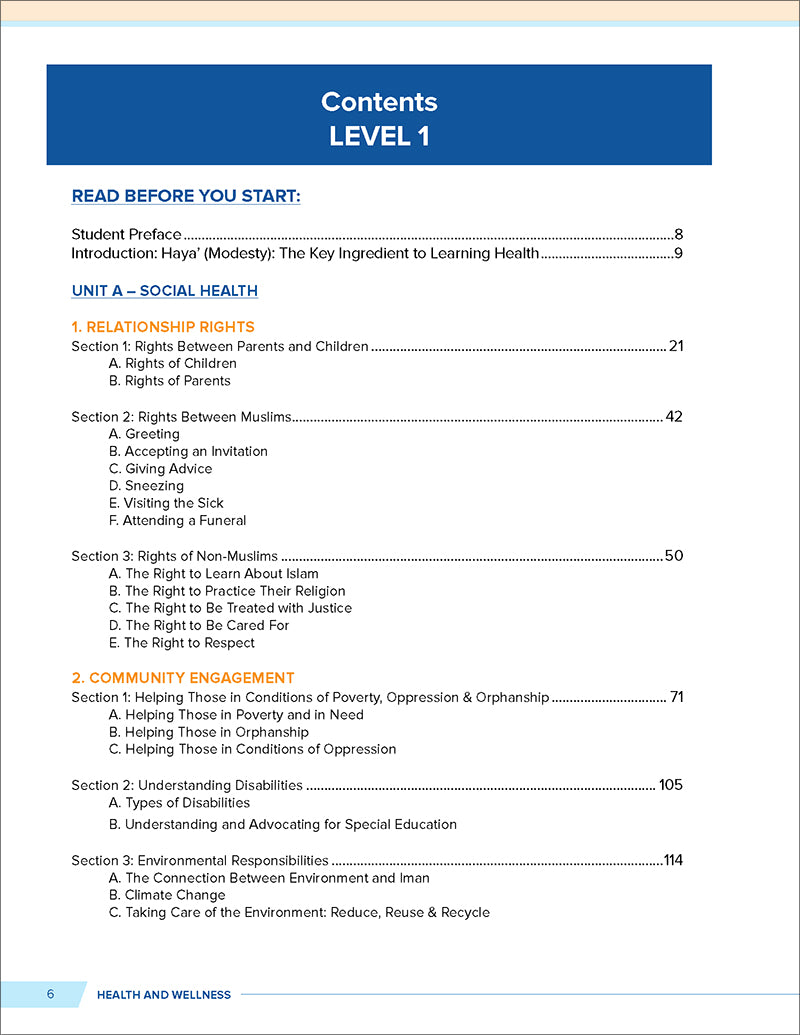
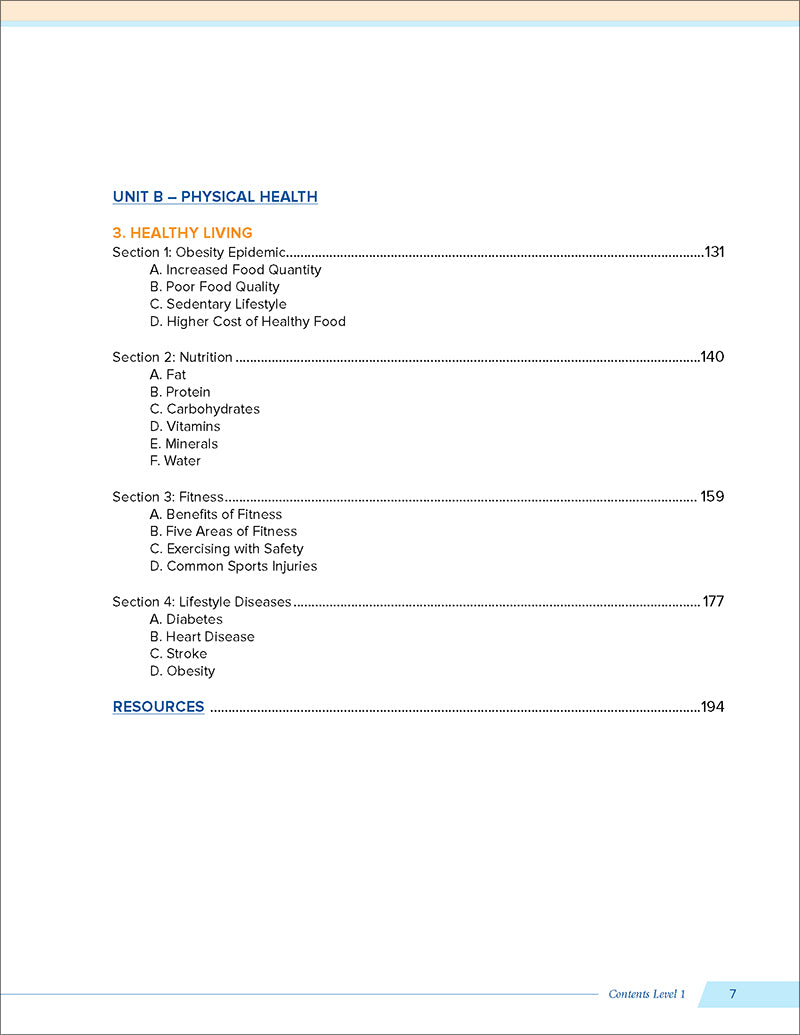
Level 1 presents topics suitable for students aged 11 and above. The first unit, Social Health, addresses topics related to navigating healthy relationships — between Muslims, between parents and children, and with non-Muslims. It also provides a roadmap for youth integration in community engagement, including helping those in need, understanding disabilities, and caring for the environment. The second unit, Physical Health, connects healthy eating and exercise with verses from the Qur’an and ahadith, as well as preventive measures against common lifestyle diseases.
Discussed topics:
Unit A: SOCIAL HEALTH
Chapter 1: RELATIONSHIP RIGHTS
Section 1: Rights Between Parents and Children.
Section 2: Rights Between Muslims
Section 3: Rights of Non-Muslims
Chapter 2: COMMUNITY ENGAGEMENT
Section 1: Helping Those in Conditions of Poverty, Oppression & Orphanship
Section 2: Understanding Disabilities
Section 3: Environmental Responsibilities
Unit B: PHYSICAL HEALTH
Chapter 3: HEALTHY LIVING
Section 1: Obesity Epidemic
Section 2: Nutrition
Section 3: Fitness
Section 4: Lifestyle Diseases
Please note that the topics are presented in a way that suits the age group. Teachers are advised to review the remaining levels in the series, where these topics are discussed in greater depth, to gain a comprehensive understanding of the overall content.
*For every 10 or more copies purchased, you’ll receive a free PDF for that level.
Click here for a brief overview of Health and Wellness Level 1
Click here to watch Navigating Healthy Relationships (Level 1) webinar
Click here to watch the author's webinars